> ## Documentation Index
> Fetch the complete documentation index at: https://docs.onyx.app/llms.txt
> Use this file to discover all available pages before exploring further.
# Users and Groups
> Manage users, account types, groups, and invitations in Onyx
## Overview
This page applies to Onyx **v4.7 and later**. For older versions,
see [Users and Groups before v4.7](/admins/user_management/users_and_groups_legacy).
Onyx allows you to manage users, account types, groups,
and invitations in your workspace from the Users and Groups pages in the Admin Panel.
### Users
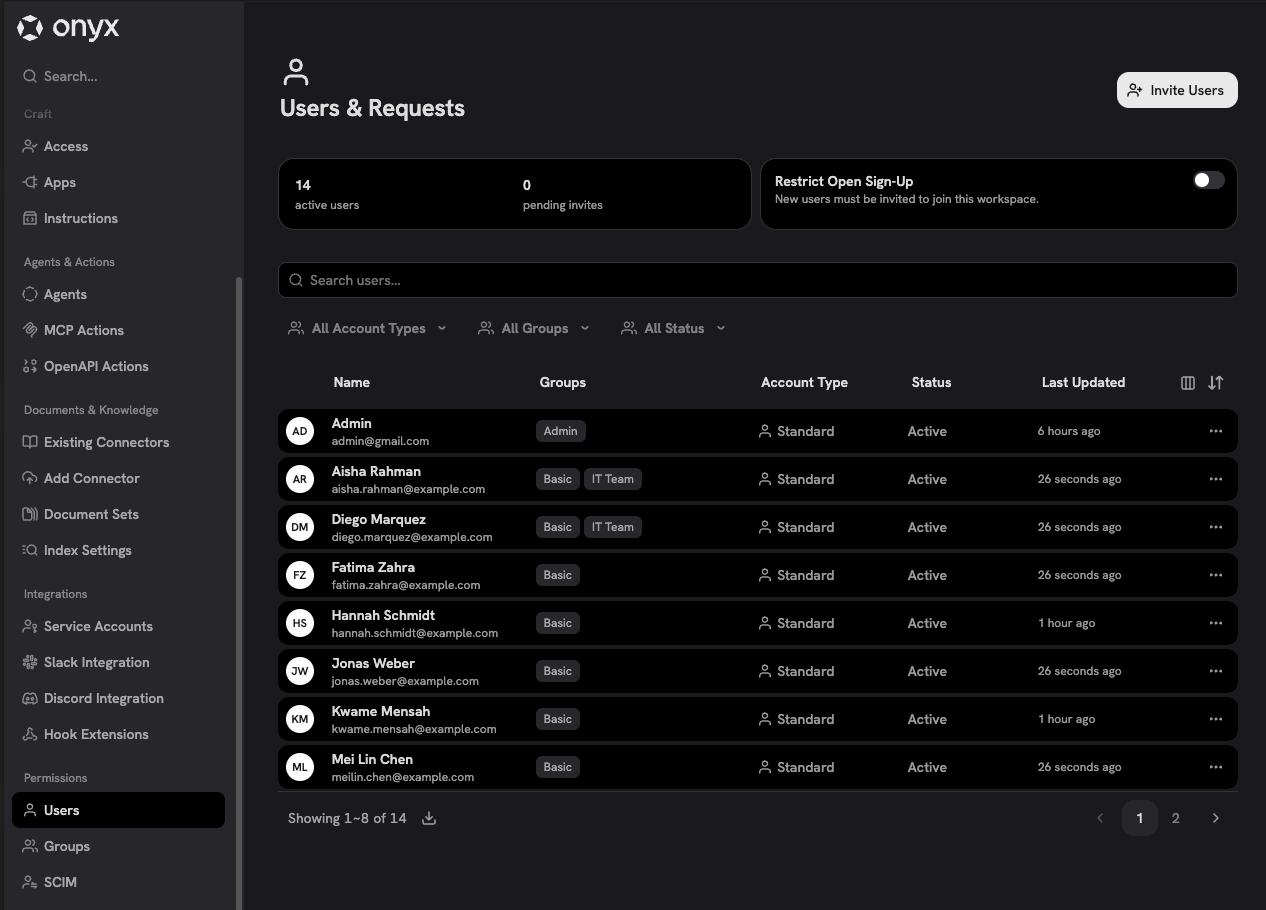
As users join your workspace, they will appear in the Users page. Each row shows the account's group membership,
account type, status, and when it was last updated. You can filter the list by account type, group, or status,
and you can invite, deactivate, reactivate, and delete users from this page.
Unable to delete a User? They may have a Document Set or Agent still associated with their profile.
 ### Account Types
Account type tells you what kind of account Onyx is showing. It is different from permissions:
permissions come from group membership, while account type explains whether the account is a normal user,
service account, or system-managed account.
| Account type | Meaning |
| --------------- | ------------------------------------------------------------------------------------------------------------------------------------- |
| Standard | A normal user account. Standard users can be assigned to groups and receive group permissions. |
| Service Account | An API key or service account. Service accounts get their access from the groups you pick when creating the key, exactly like a user. |
| Slack Bot | A bot-created account used for Slack interactions. These accounts are system-managed. |
| External User | A placeholder account discovered through external permission sync before the person logs in. These accounts are system-managed. |
| Anonymous | A temporary anonymous account when anonymous access is enabled. These accounts are system-managed. |
Most day-to-day user management happens with **Standard** users.
Use groups to control what Standard users and Service Accounts can access or manage. Slack Bot, External User,
and Anonymous accounts are created by system workflows and are not usually edited directly.
Because all access comes from groups, an account that belongs to no group has no permissions.
A service account with no group is the one exception: it can still post to chat, but it cannot search.
See [Understanding Permissions](/admins/permissions/understanding_permissions) for the full model.
### Inviting Users
Use the **Invite Users** button to send an email invitation to join your workspace.
Inviting someone does not by itself change who is allowed to join.
### Restricting Who Can Join
By default, anyone who can reach your Onyx deployment can create an account. To require an invitation instead,
turn on **Restrict Open Sign-Up** on the Users page. While it is on, only people you have invited can join.
**Restrict Open Sign-Up** appears on self-hosted deployments when SCIM is not enabled.
If you turn on [SCIM](/deployment/authentication/scim),
the SCIM status replaces it on the Users page and your identity provider controls membership instead.
## Groups
You can organize users and service accounts into groups to manage access at the same time.
Specifically, you can attach private Connectors, Document Sets, and Agents to a Group,
granting all users in the Group access to these resources.
Additionally, you can impose token rate limits on a Group to monitor and control AI model usage.
Groups also power Onyx's permission system. To learn how group permissions and Group Managers work,
see [Understanding Permissions](/admins/permissions/understanding_permissions).
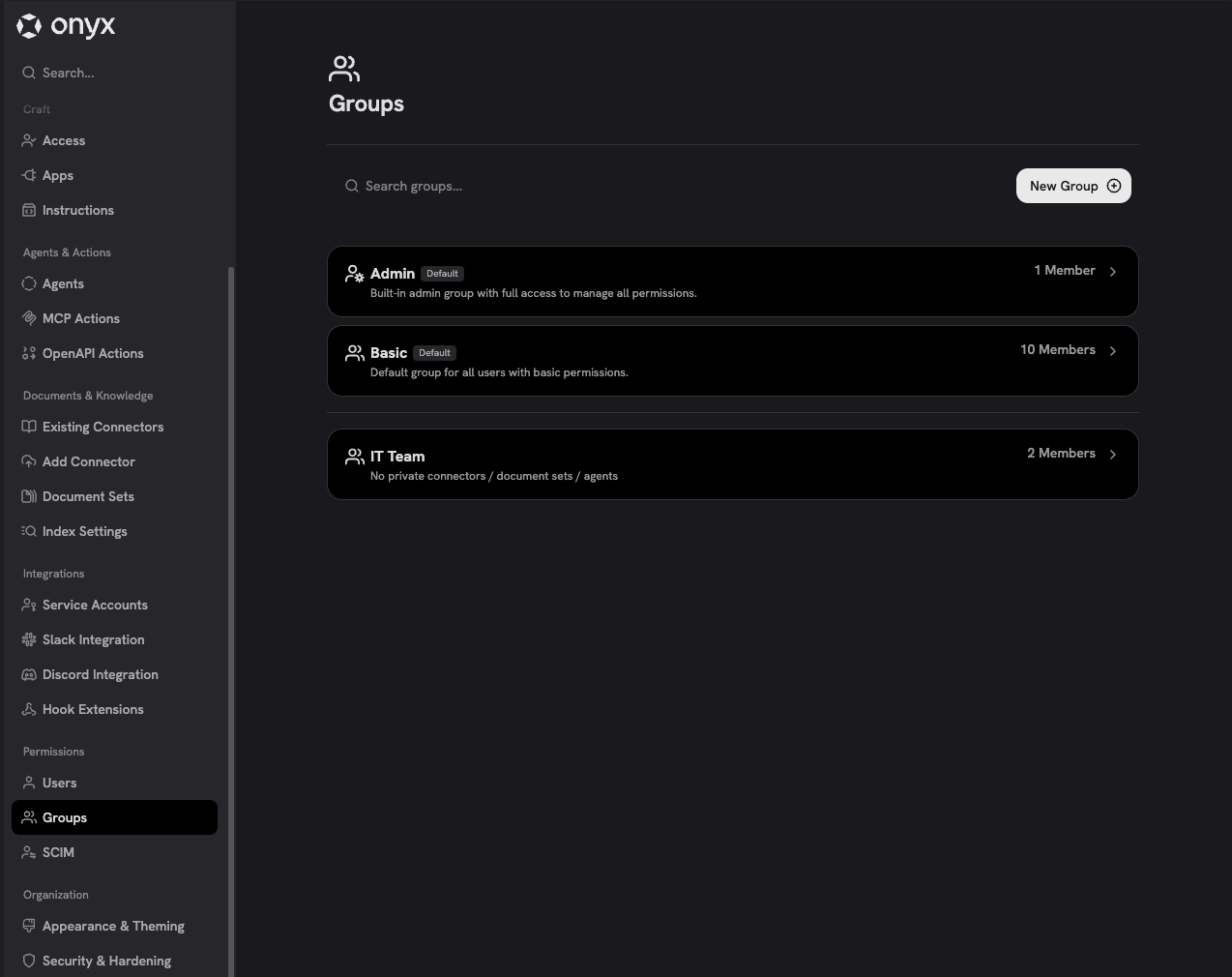
The Groups page lists every group in your workspace with its member count.
The built-in **Admin** and **Basic** groups are marked **Default**. Use **New Group** to create a custom group.
### Account Types
Account type tells you what kind of account Onyx is showing. It is different from permissions:
permissions come from group membership, while account type explains whether the account is a normal user,
service account, or system-managed account.
| Account type | Meaning |
| --------------- | ------------------------------------------------------------------------------------------------------------------------------------- |
| Standard | A normal user account. Standard users can be assigned to groups and receive group permissions. |
| Service Account | An API key or service account. Service accounts get their access from the groups you pick when creating the key, exactly like a user. |
| Slack Bot | A bot-created account used for Slack interactions. These accounts are system-managed. |
| External User | A placeholder account discovered through external permission sync before the person logs in. These accounts are system-managed. |
| Anonymous | A temporary anonymous account when anonymous access is enabled. These accounts are system-managed. |
Most day-to-day user management happens with **Standard** users.
Use groups to control what Standard users and Service Accounts can access or manage. Slack Bot, External User,
and Anonymous accounts are created by system workflows and are not usually edited directly.
Because all access comes from groups, an account that belongs to no group has no permissions.
A service account with no group is the one exception: it can still post to chat, but it cannot search.
See [Understanding Permissions](/admins/permissions/understanding_permissions) for the full model.
### Inviting Users
Use the **Invite Users** button to send an email invitation to join your workspace.
Inviting someone does not by itself change who is allowed to join.
### Restricting Who Can Join
By default, anyone who can reach your Onyx deployment can create an account. To require an invitation instead,
turn on **Restrict Open Sign-Up** on the Users page. While it is on, only people you have invited can join.
**Restrict Open Sign-Up** appears on self-hosted deployments when SCIM is not enabled.
If you turn on [SCIM](/deployment/authentication/scim),
the SCIM status replaces it on the Users page and your identity provider controls membership instead.
## Groups
You can organize users and service accounts into groups to manage access at the same time.
Specifically, you can attach private Connectors, Document Sets, and Agents to a Group,
granting all users in the Group access to these resources.
Additionally, you can impose token rate limits on a Group to monitor and control AI model usage.
Groups also power Onyx's permission system. To learn how group permissions and Group Managers work,
see [Understanding Permissions](/admins/permissions/understanding_permissions).
The Groups page lists every group in your workspace with its member count.
The built-in **Admin** and **Basic** groups are marked **Default**. Use **New Group** to create a custom group.
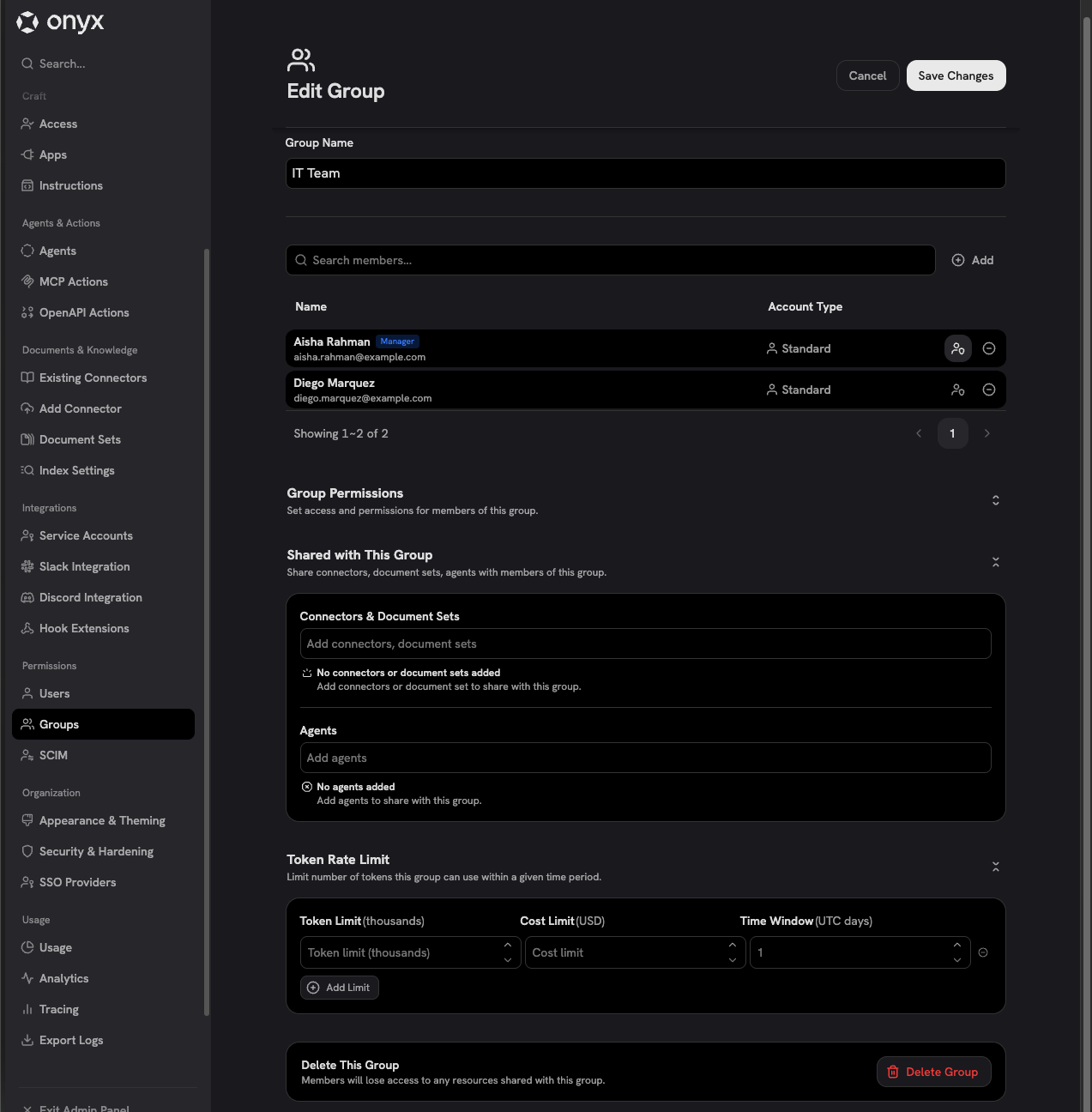
 Selecting a group opens its detail page. From here you manage the group's members, its permissions, the connectors,
document sets, and agents shared with it, and its token rate limits.
Members who manage the group are marked with a **Manager** badge.
Selecting a group opens its detail page. From here you manage the group's members, its permissions, the connectors,
document sets, and agents shared with it, and its token rate limits.
Members who manage the group are marked with a **Manager** badge.
 Want to automate user and group provisioning? Set up [SCIM](/deployment/authentication/scim)
to sync directly from your identity provider.
Want to automate user and group provisioning? Set up [SCIM](/deployment/authentication/scim)
to sync directly from your identity provider.